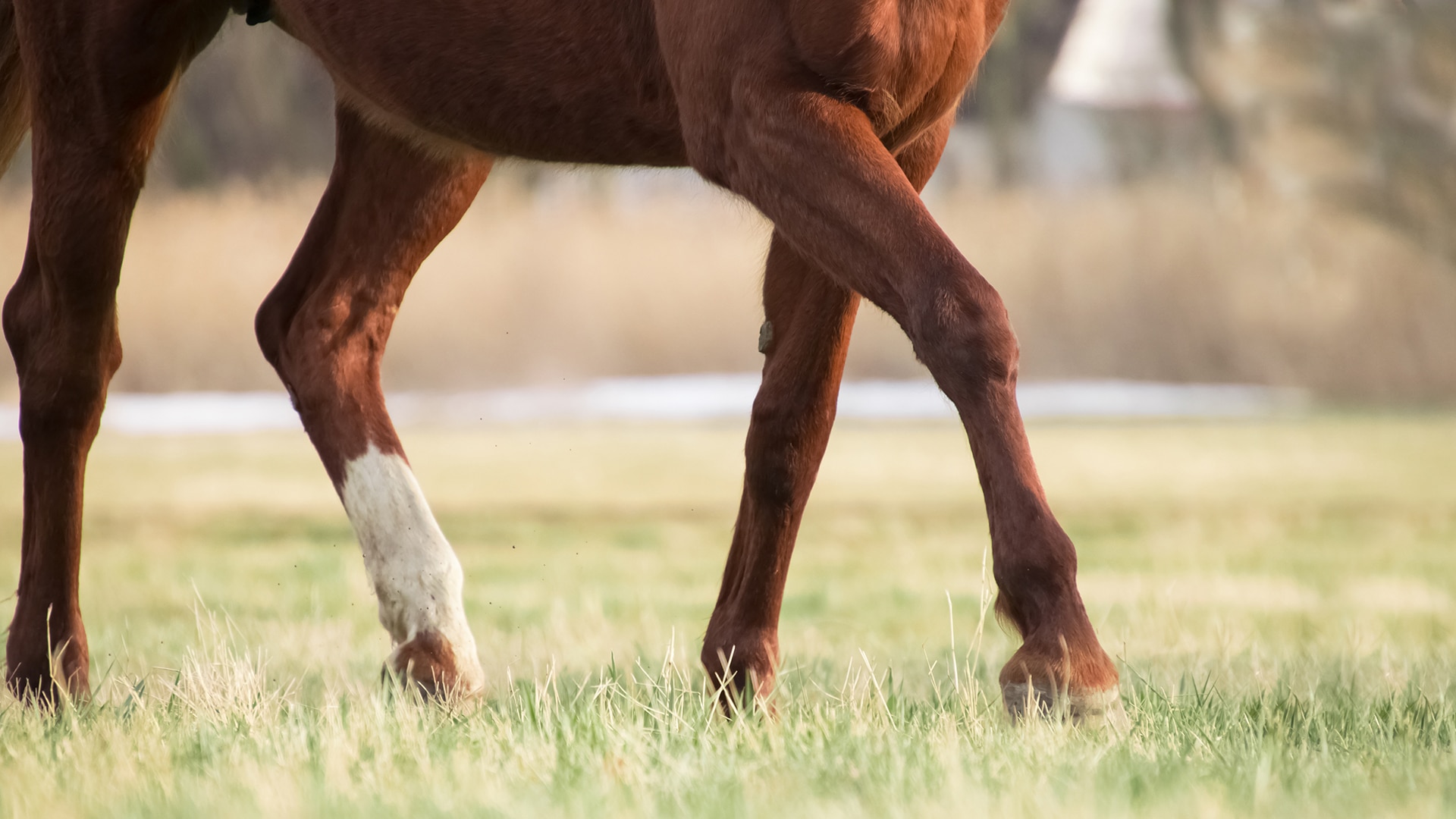
Nerve blocks can be a useful diagnostic tool, particularly for soundness issues in the legs.


Most people who have horses would have had to deal with a lame horse at some time. A nerve block is a handy procedure used by vets to identify those hard-to-pin-down sources.
Sometimes the source of the lameness is easily defined by simple examination… a hot foot, a swollen knee or response to manipulation. But sometimes the horse is lame, and no specific site of soreness is identifiable. In these cases, the veterinarian may choose to do a nerve block to localise the pain.
So, what is a nerve block? A nerve block is a procedure where a small quantity of local anaesthetic is deposited either beside a nerve or into a joint to deaden the sensation of the area supplied by that nerve. It is commonly used to identify lameness in the foot as it is not always easy to pick problems inside the hoof wall unless there are obvious abnormalities. Other common sites that are blocked include the fetlocks, knees and hocks, however, in theory nearly every joint in the body could be blocked with the appropriate technique and equipment.
Nerves have two major roles: one to give signals to parts of the body to produce an action, and two, to relay messages such as pain and position back to the brain. By blocking the sensory portion of the nerve, the brain does not receive the input to say that something hurts. Therefore, if the nerve relaying pain from the foot back to the brain is blocked or desensitised, the horse will trot feeling no pain and trot out soundly (referred to as a positive response to a nerve block). Similarly, if the knee is blocked and this is the site of lameness, the horse will be sound. If the foot is blocked and the knee is the source of lameness, the horse will still be lame when trotted out (referred to as a negative response to a nerve block).

Following a nerve block, if the horse trots out soundly it is referred to as a ‘positive response’.
As nerves travel from the brain, they continually branch into smaller and smaller nerves, spreading throughout the body. Conversely, sensory nerves, as they travel up from the body’s extremities to the brain, join up to form larger nerves. This means the closer we desensitise a nerve to its source of pain, the more specific we can be as to the origin of the pain. For this reason, nerve blocks are usually conducted in a logic progression, starting at the foot and moving up the leg. Therefore, a block conducted down by the heels will typically diagnose any problem associated with the back part of the foot (i.e. the heels or navicular bone). A block done in the upper pastern region will usually deaden all of the foot and everything from the pastern down. A block down on the lower aspect of the cannon will desensitise the fetlock, the foot and the pastern. The higher we move up the leg, the more structures we will be blocking. The exception to this would be if a joint is blocked and the block is assessed within a defined period; a positive response is reasonably specific to that joint.
When conducting nerve blocks, we can utilise regional blocks to help localise the pain to a larger area so that the process can potentially be done more quickly. It is not unusual for initial nerve blocks to be done to localise the lameness to a particular region, and then to do some follow-up blocks at another time to be more specific with the site of lameness. An example of this would be to block the lower limb at the level of the fetlock joint (what is known as an abaxial block) and, if this is positive, to return in the days that follow and block the heels or the coffin joint. In the hind limb, it is not uncommon to do the initial block above the fetlock to desensitise the fetlock and foot, and then jump to blocking the two nerves above the hock. If either of these blocks are positive, the vet would then have to do more blocks or diagnostic procedures to investigate the lameness.
ARE THERE ANY NEGATIVES?
There are a number of disadvantages to conducting nerve blocks. Perhaps the most serious is the risk that the horse may injure itself further if trotted on a limb that is desensitised. Pain is the body’s own defence mechanism to protect itself from further damage. Therefore, there is the potential that if a horse has a fracture in a bone and the area is blocked, this fracture may become worse when the horse trots out, bearing weight on the limb. This risk is usually minimised if the horse is examined carefully and a thorough history is taken prior to blocks being conducted, as the vet will elect to take survey X-rays before blocking a structure to rule out possible fractures. Where it is high risk is when a block is done and the horse is taken out and worked at high speeds. This practice is used to identify lameness that is only detected at these fast gaits.
The second disadvantage to conducting blocks is the solution used to anaesthetise the nerve can be a little irritating and some residual swelling may occur following the procedure. Fortunately, this is usually only a temporary problem and can be minimised by the use of things such as bandaging and administration of some anti-inflammatories.

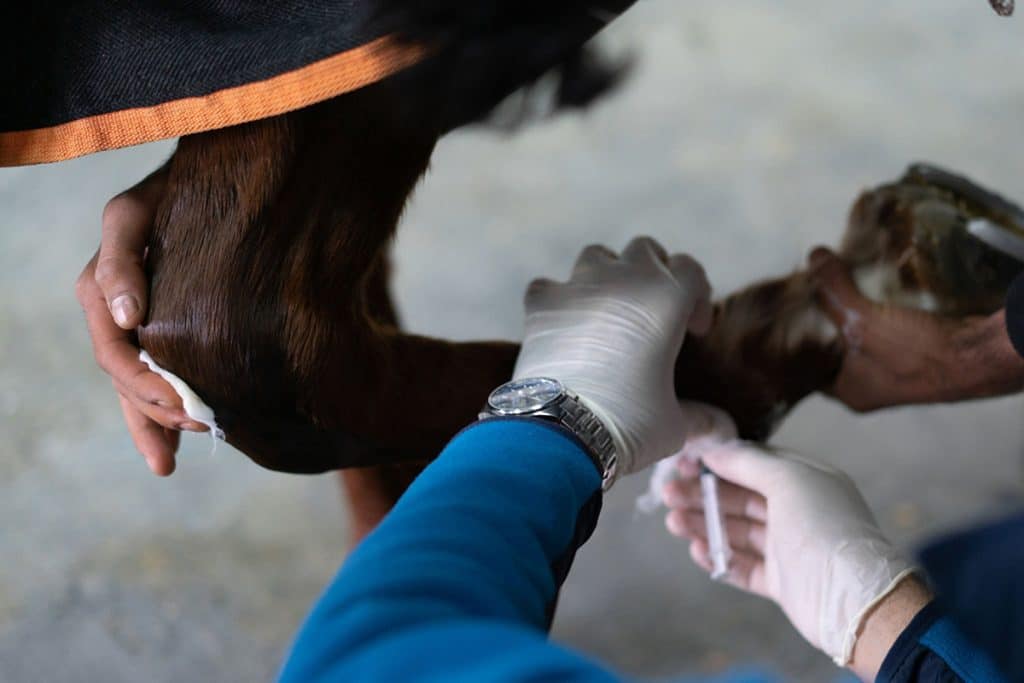
Injecting into a joint does carry a risk of infection and so most vets will take added precautions when injecting these structures.
“Nerve blocks are very
useful procedures to help
the vet diagnose a problem.”
Injecting into a joint or a tendon sheath also carries a risk of infection. This is not isolated to nerve blocks, as anything injected into a joint or sheath (termed synovial structures) does carry a risk of infection and so most vets will take added precautions when injecting these structures (i.e. gloves and sterile preparation of the area prior to injection).
Risks are not isolated to just the horse, either. Anyone who has ever had local anaesthetic injected would know that it can sting. Thus, some horses aren’t too obliging when being blocked and blocks to the hind limb carry a significant risk to the vet of being kicked. For this reason, some horses will require a twitch applied or a very low dose of sedation administered to enable the procedure to be done.
Nerve blocks are very useful procedures to help the vet diagnose a problem, and although they aren’t without risk to both horse and human, the benefits far outweigh these risks. EQ
Related articles

Horses are very reliant on their eyes for sight and depth perception. Anything that affects their eyes has the potential to significantly impact their ability to survive in the wild. For domestic horses, eye issues can affect performance as well as day-to-day life.

X-rays can be a valuable tool during pre-purchase examinations but make sure you have a clear understanding of what is involved, says veterinarian Dr Maxine Brain.