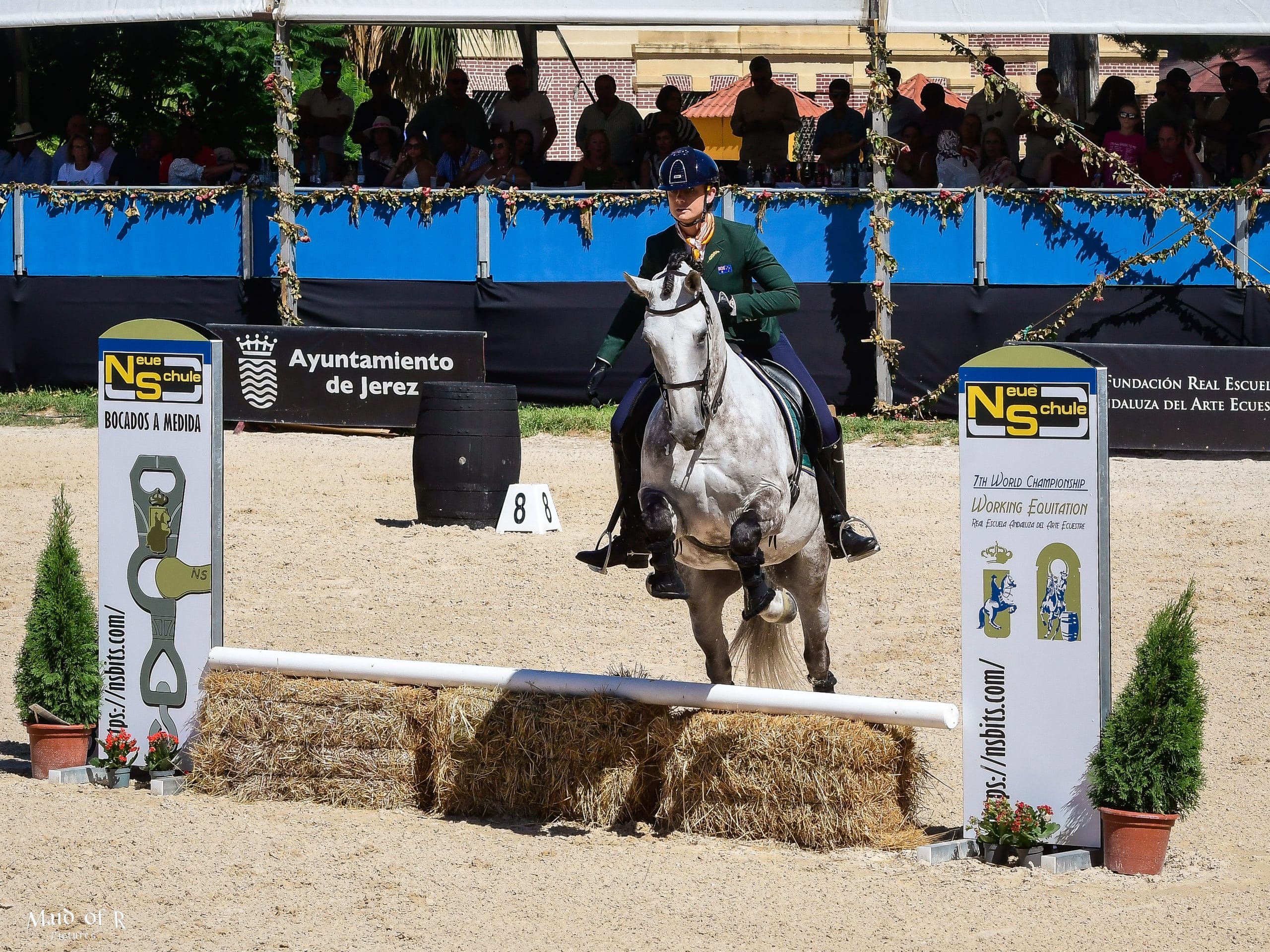
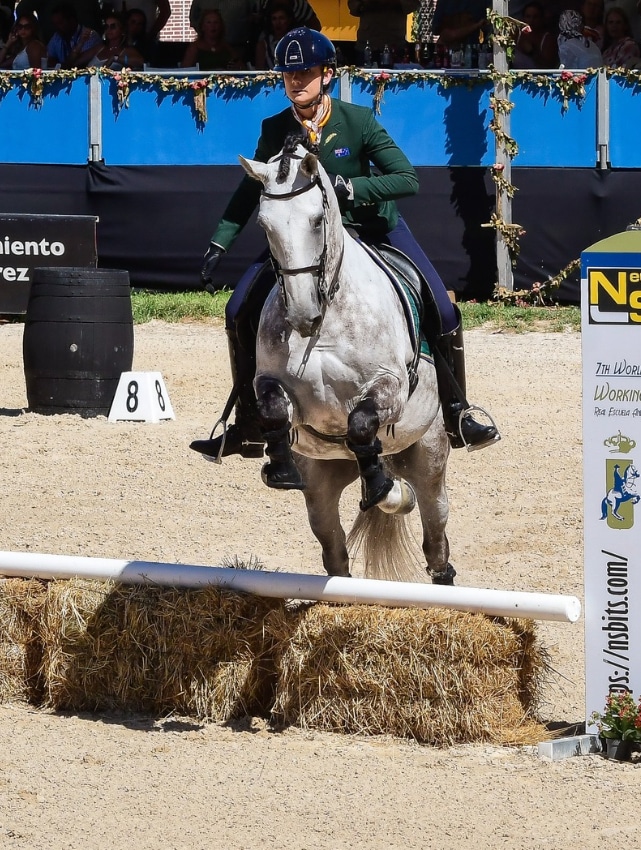
Tammy Patch and Pegaso representing Australia at the 2026 World Association for Working Equitation (WAWE) World Championship. Image by Maid of R Pictures/Brigitte Graffenberger.


Perry Nancarrow and H-Bacara, Tammy Patch and Pegaso, Elizaveta Strounina and Enamorador YDM, and Karen Yanik and Otello will forever be remembered in Australian Working Equitation history as members of the first team to represent Australian National Working Equitation (ANWE) at a World Association for Working Equitation (WAWE) World Championship.
The 7th WAWE World Championship was held in Jerez de la Frontera, Spain, within the iconic grounds of the Royal Andalusian School of Equestrian Art. Being there was not only a significant milestone for the sport in Australia, but also a spectacular setting in which to establish Australia’s international presence on the world stage.
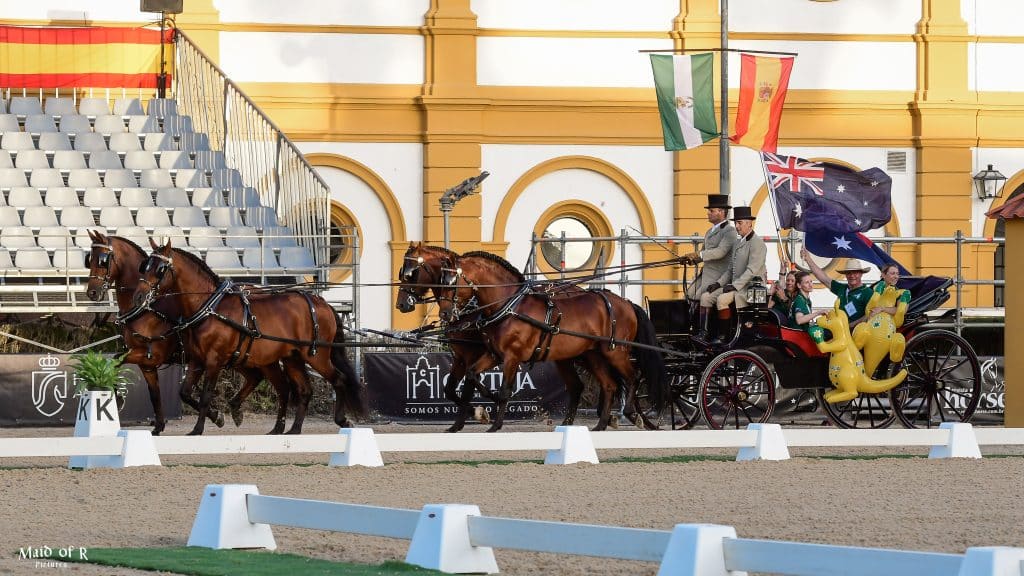
The Australian team during the opening ceremony at the 2026 WAWE World Championship. Image by Maid of R Pictures/Brigitte Graffenberger.
Much like the slow and steady development of a horse in training, the development of Working Equitation as a sport in Australia has taken years of hard work, dedication and sacrifice by many passionate individuals, creating the building blocks for the riders who will follow.
Working Equitation consists of four phases: Dressage, Maneability (or Ease of Handling, as it is known in Australia), Speed and Cattle. At all levels, Working Equitation can be considered a team sport. Although the team members, based in both Australia and Europe, had never met in person or worked together before the championship, they soon built an admirable camaraderie.
They faced each phase not only as individual riders, but with the backing and support of a team, riding with determination, skill and the collective spirit of Australia to secure an impressive 10th place among 22 nations.
AN EXTRAORDINARY JOURNEY
Beyond the riders, a strong contingent of approximately 80 Australian supporters travelled to Spain to cheer on the Australian team and embrace all things Working Equitation in a location steeped in history and culture.
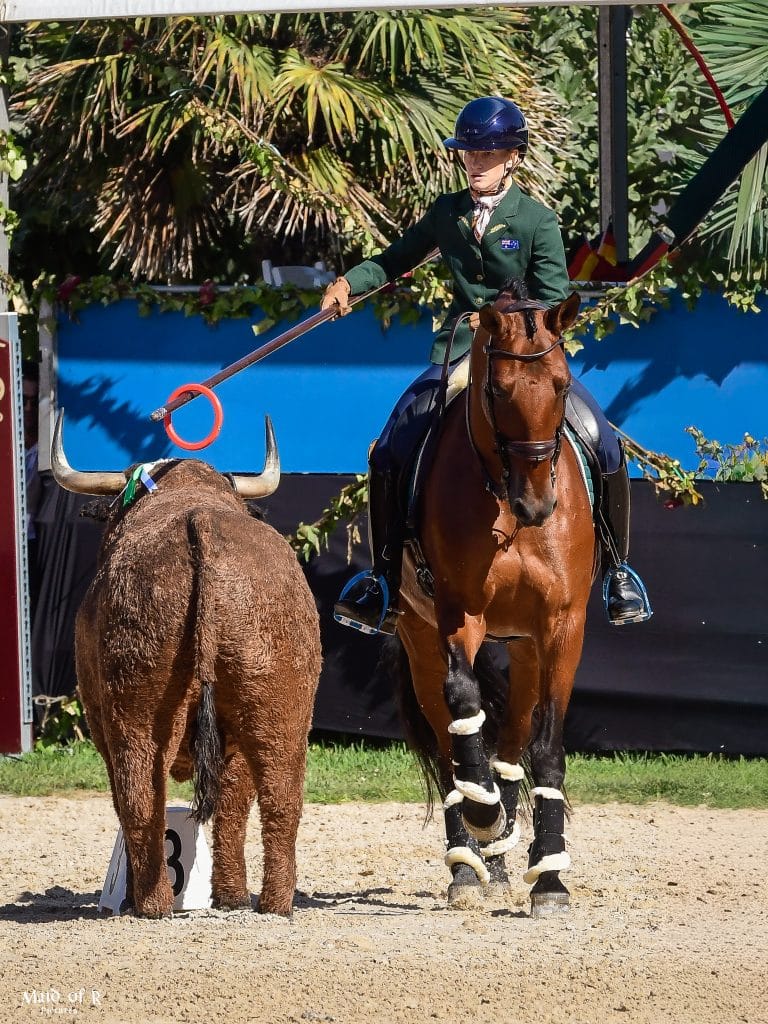
Elizaveta Strounina and Enamorador YDM during the Maneability phase. Image by Maid of R Pictures/Brigitte Graffenberger.
The lead-up to the championship was remarkable in itself. Online travel groups were formed, chat groups established, accommodation coordinated, training opportunities encouraged, and travel arrangements and group tickets organised. Every effort was made to ensure travellers had the opportunity to embrace the full experience, make new friends, learn new skills and enjoy everything the event had to offer.
Perry and Elizaveta, both based in Europe, were able to compete on their own horses, while Tammy and Karen competed on loaned horses. Several weeks before the championship, Tammy travelled to Portugal and Karen to Belgium to build a partnership with their chosen mounts before making their way to Spain. This created another challenge for the two Australian-based riders.
Although each rider had qualified on their own horse, the distance and expense involved meant that, like many nations including Australia, they were given the opportunity to compete on a loaned horse of suitable standard.
It may appear on the surface to be an easy task to step onto a well-trained horse. However, these horses are finely tuned, will only perform as well as they are ridden and, in many cases, brilliance comes with a certain amount of “character”. Fast-tracking a relationship and building trust is therefore something that can only truly be pressure-tested at the event itself.
Upon arrival in Jerez, the team was greeted by temperatures soaring into the high 30s. With the horses housed in enclosed temporary stables, the need for additional resources to keep them comfortable quickly became apparent. Once again, the supporters rallied, sourcing fans, power leads and other essential items to help ensure the wellbeing of riders and horses ahead of the veterinary inspection and competition.
STEPPING ONTO THE WORLD STAGE
The first day of competition saw three of the four Australian riders enter the arena. Each rode with something far greater than simply a desire to compete. They carried with them countless hours of training, the challenges they had overcome, the lessons they had learned and, ultimately, the hopes and dreams of every Australian supporter. They had to muster the courage required to perform among the world’s elite riders.
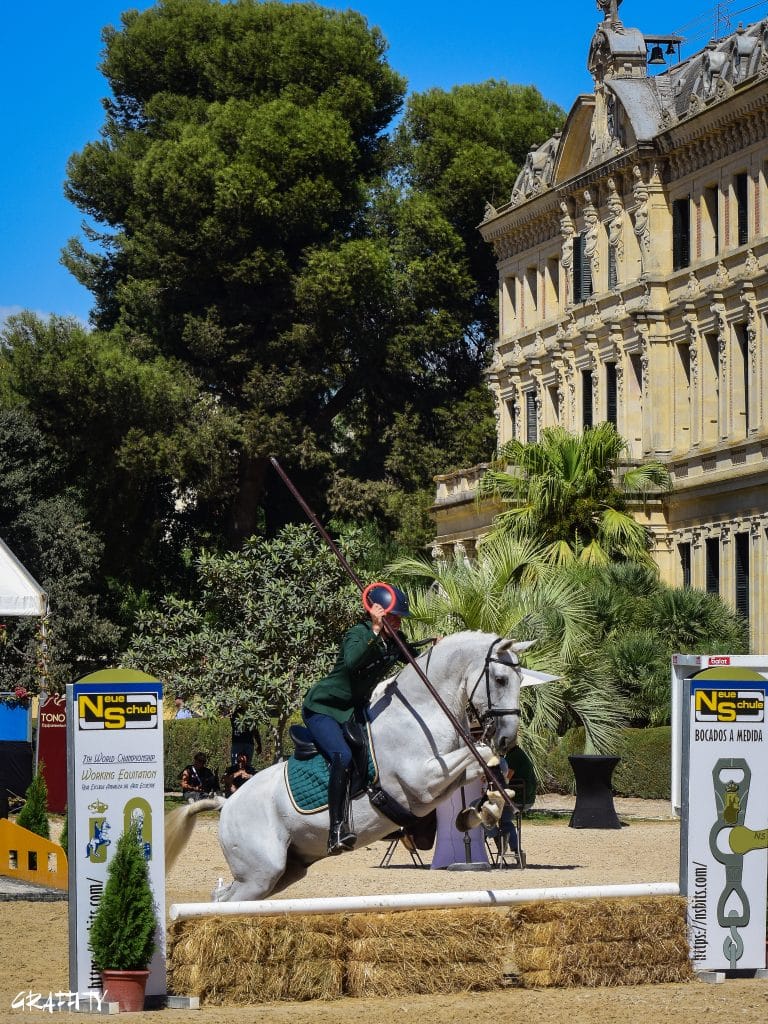
Perry Nancarrow and H-Bacara in action. Image by Graffity/Uwe Graffenberger.
“Perry and H-Bacara
thrived under pressure…”
Elizaveta and Enamorador, with years of public performance under their girth, demonstrated a powerful partnership, blending grace with athleticism. Their connection was evident from the moment they entered the arena, reflecting the trust, understanding and countless hours they have shared throughout Enamorador’s life.
Perry and H-Bacara thrived under pressure, maintaining accuracy and precision when it mattered most. H-Bacara’s enthusiastic nature meant careful warm-up management was essential, but together they produced a memorable performance.
Karen and Otello overcame some early communication challenges as they encountered the new environment. Nevertheless, riding with quiet confidence, they delivered beautiful work while navigating difficult moments with grace, determination and composure.
Tammy and Pegaso gave their all and delivered an admirable result, with Tammy riding with a smile from start to finish. It may not have been a perfect performance, but it was undeniably spirited, showcasing Tammy’s trademark determination, positivity and can-do attitude.
For the Maneability phase, which essentially demonstrates the ease of handling through a series of obstacles, competitors were given just 30 minutes to walk the course and plan their rides.
Karen faced the additional challenge of competing in the first group, meaning she had no opportunity to observe how others approached the course. Reflecting afterwards, Karen joked that she “had to ride Otello like she stole him” to negotiate the exceptionally tight turns. She credited both the horse and the experience with teaching her valuable lessons that she will carry forward.
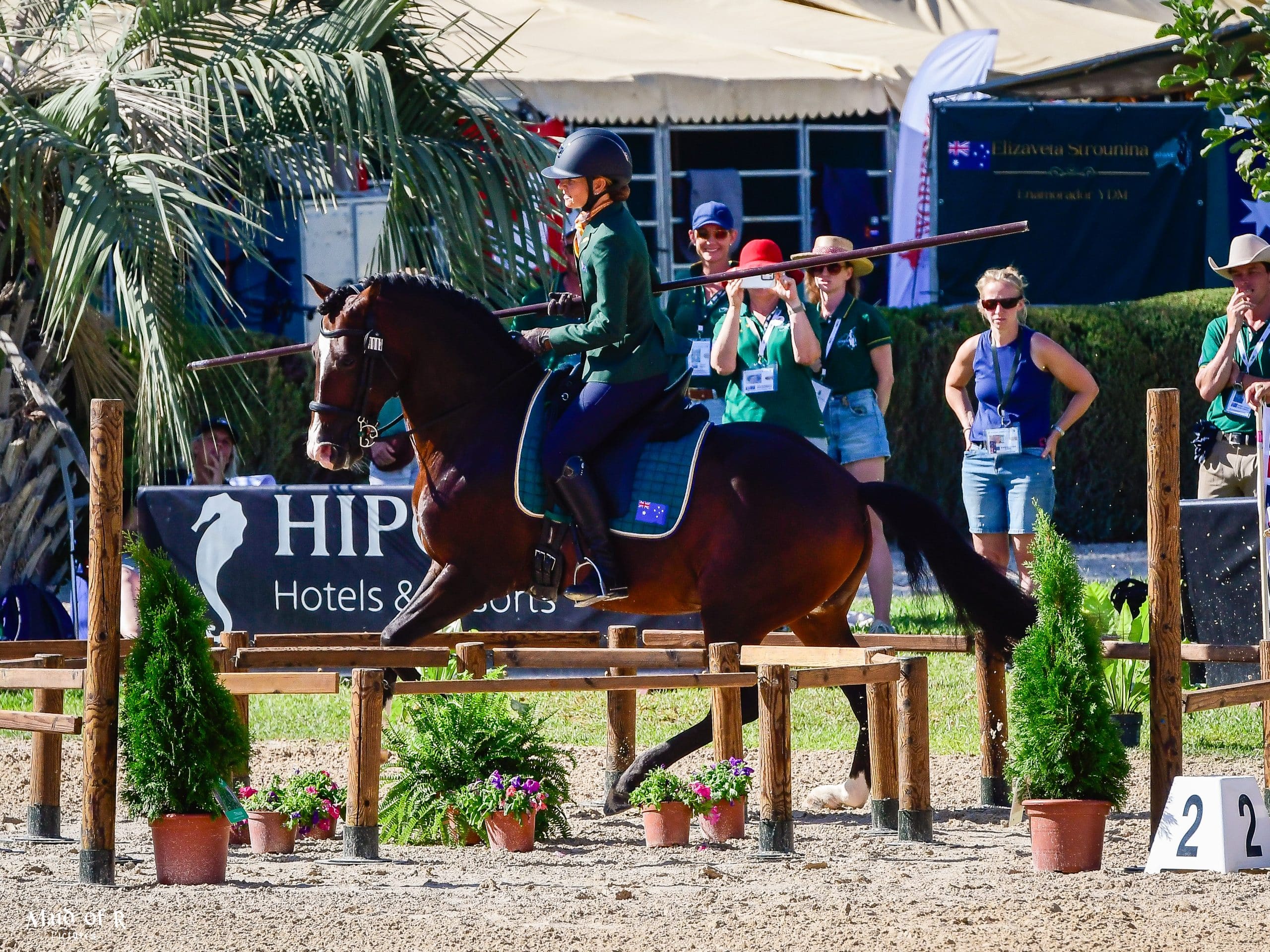
Karen Yanik and Otello, whom the Australian rider borrowed from Belgium for the championship. Image by Maid of R Pictures/Brigitte Graffenberger.
Perry and H-Bacara then delivered a masterful Maneability test, finally breaking through their elusive 70 per cent barrier and, for a moment, placing Perry in the lead.
In the Speed phase, Tammy drew on her mounted games experience, producing a blisteringly fast round. Unfortunately, a handful of penalties from knocked poles pushed her back to 15th place in the Speed standings.
SEA OF GREEN AND GOLD
At the end of every Australian performance, a familiar cry rang out across the arena:
“Aussie, Aussie, Aussie!”
From every corner of the grandstand, the travelling Australian supporters replied:
“Oi, Oi, Oi!”
Their voices carried throughout the venue, creating an atmosphere that was impossible to ignore.
THE TOUGHEST TEST
There was no denying that the Cattle phase proved the greatest challenge for many competitors. The cattle were large, tough, courageous and often unpredictable, moving as a formidable herd. Once one animal broke away, the rest frequently followed with considerable force.
For the Australian team, this was their first time competing together in the Cattle phase at an event of this scale. Watching them support, encourage and learn from each other highlighted the strength of their teamwork.
Unfortunately, they were unable to pen their individually allocated beasts. In fact, only 10 individual riders successfully penned their assigned animal within the allotted time, demonstrating just how difficult the challenge was.
To a rider with team penning or cutting experience, the performance may have appeared to represent a missed opportunity, or perhaps the task might have seemed easier than anticipated. However, it is important to acknowledge the cultural origins of Working Equitation.
The sport is deeply rooted in the traditional practices of France, Italy, Portugal and Spain. Unlike the cattle more commonly encountered in Australian competition, the cattle used at this championship came from a long line of bullfighting stock. They were neither quiet nor compliant, and they met each new team as a challenge.
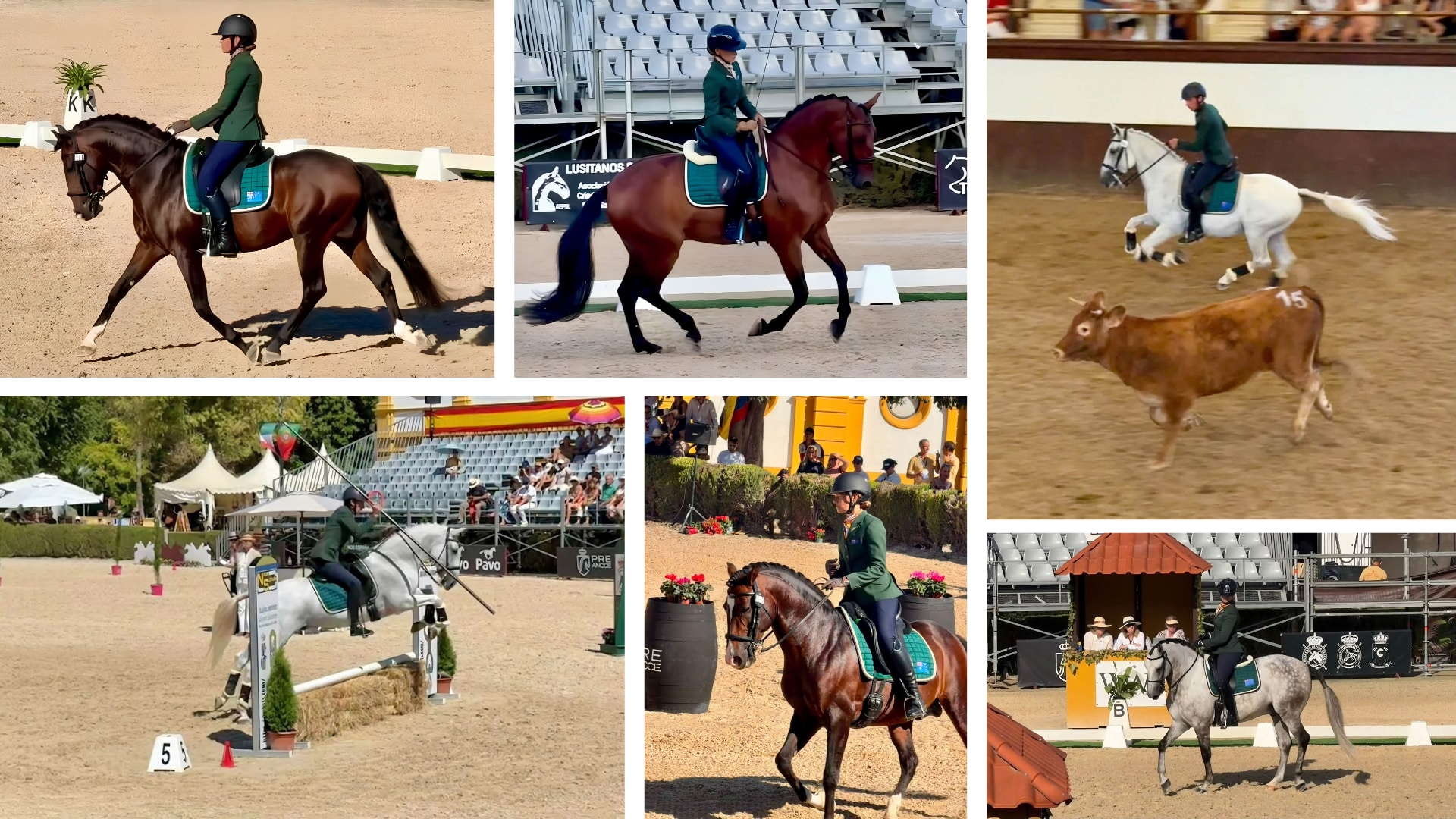
Competitors completed four phases: Dressage, Maneability (or Ease of Handling, as it is known in Australia), Speed and Cattle. The latter was the most challenging. Images supplied.
UNFORGETTABLE GRANDSTAND MOMENT
During one of the extended breaks to rest the cattle, temperatures climbed to around 37 degrees. As the heat, discomfort and boredom began to set in, something unexpected happened. From a far corner of the grandstand came a movement and a cheer that, once recognised, transcended every language barrier.
Before long, the entire audience, stretching from one side of the arena to the other, was united in a spontaneous Mexican wave. It rolled around the stadium again and again, first in one direction, then the other. When the wave finally subsided, a chant erupted:
“USA! USA! USA!”
The Australians quickly responded:
“Aussie, Aussie, Aussie! Oi, Oi, Oi!”
A brief silence followed as everyone waited to see what would happen next. The official announcer, who had already called for “Quiet please!” more times than anyone could count during the Cattle phase, suddenly began singing a verse of Waltzing Matilda. With what was left of the Australians’ voices, the chorus went on!
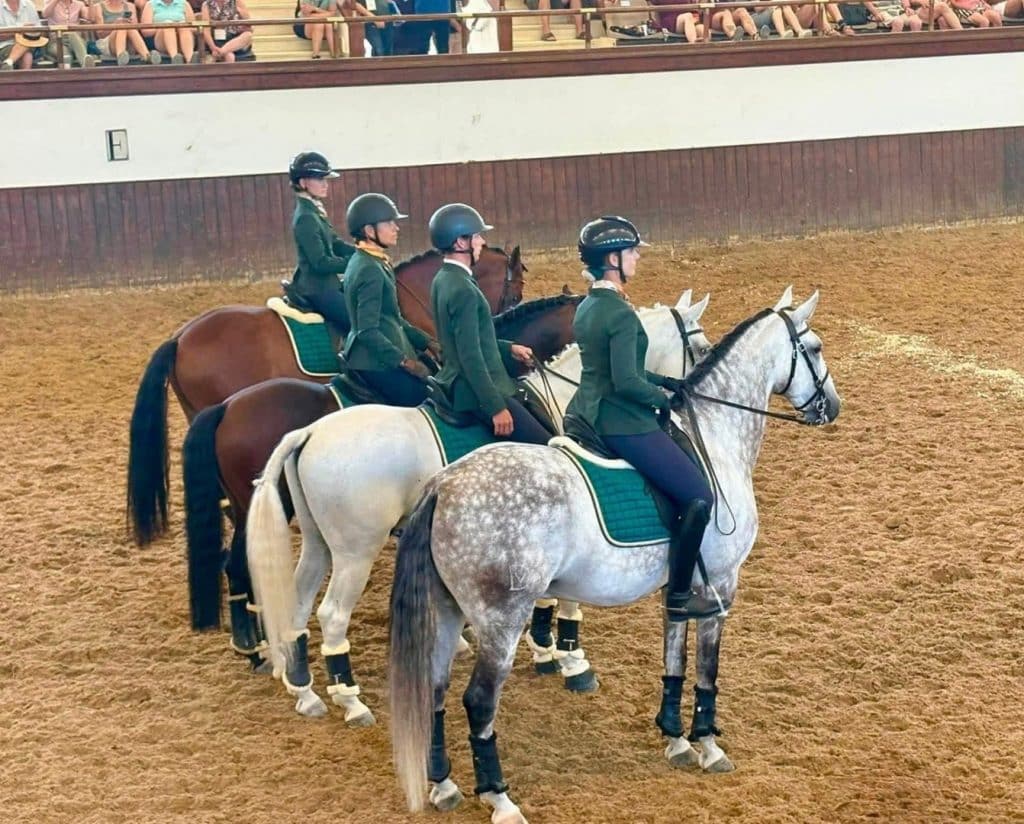
Australia’s debut appearance at a WAWE World Championship was an extraordinary achievement. Image supplied.
“What an extraordinary
achievement in Australia’s
debut appearance…”
The announcer then led chants celebrating each competing nation. The crowd responded enthusiastically, united in a collective and inclusive celebration unlike anything many had experienced before. It was joyful, spontaneous and utterly unforgettable.
A PROUD BEGINNING
What an extraordinary achievement in Australia’s debut appearance at a WAWE World Championship. This was never simply about four riders and four horses. It was about a team — a team whose members were admired not only for their accomplishments, but also because they remained approachable, relatable and willing to share their experiences.
In doing so, they provided inspiration and guidance for the next generation of Australian Working Equitation riders, leaving a legacy that extends far beyond the competition arena. EQ

Related articles
The 2026 Brisbane CDI marked another milestone for Queensland dressage rider Jacqueline (Jacqui) Huppert, whose recent success with her two talented German Riding Ponies is another highlight of her lifetime spent pursuing equestrian excellence.
As well as transforming the image of equestrian sports in Australia with the ground-breaking Usherettes, Janice Underwood has also rubbed shoulders with royalty and riding greats in her remarkable career, as we discover in this second half of our two-part series.