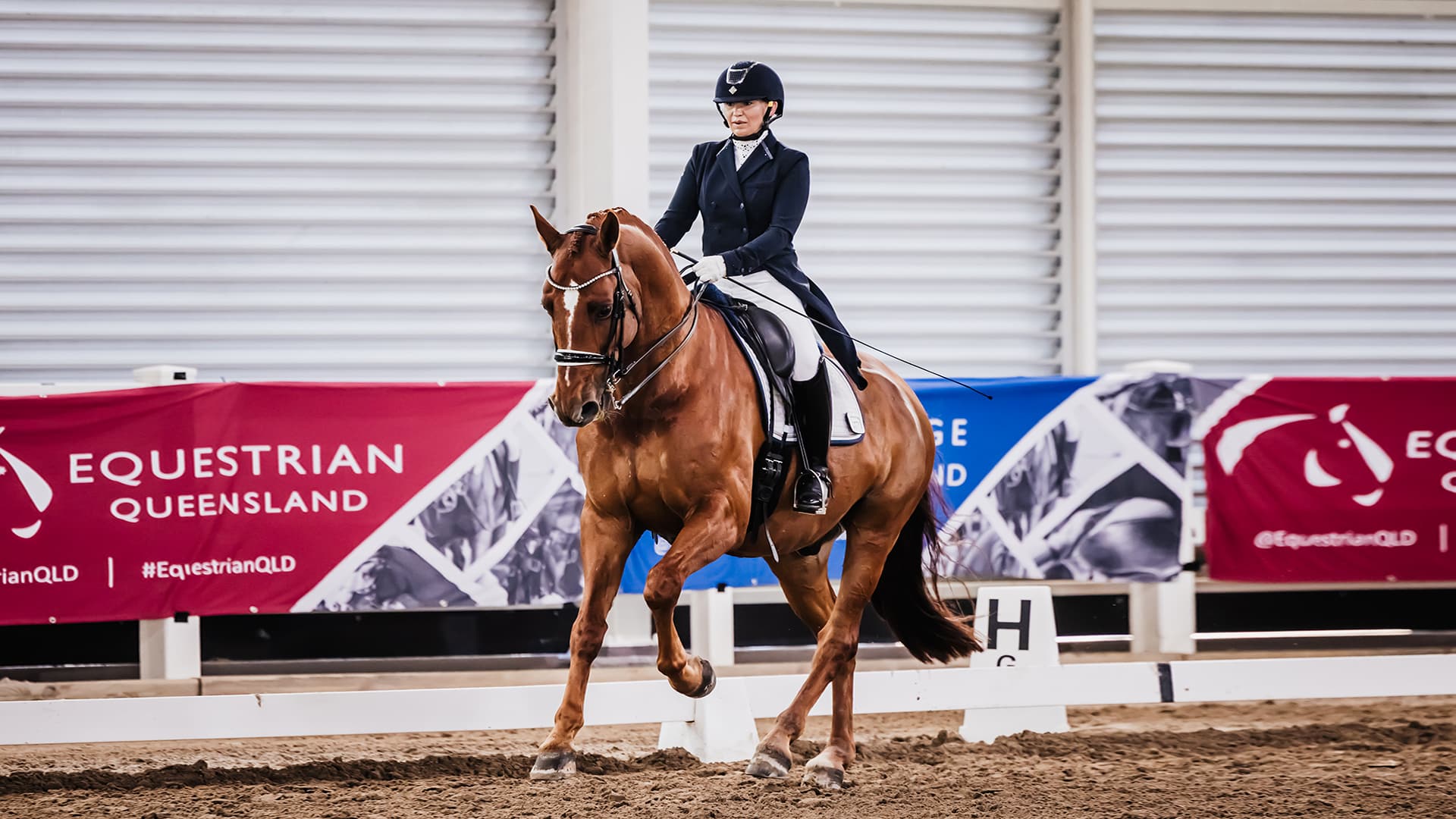
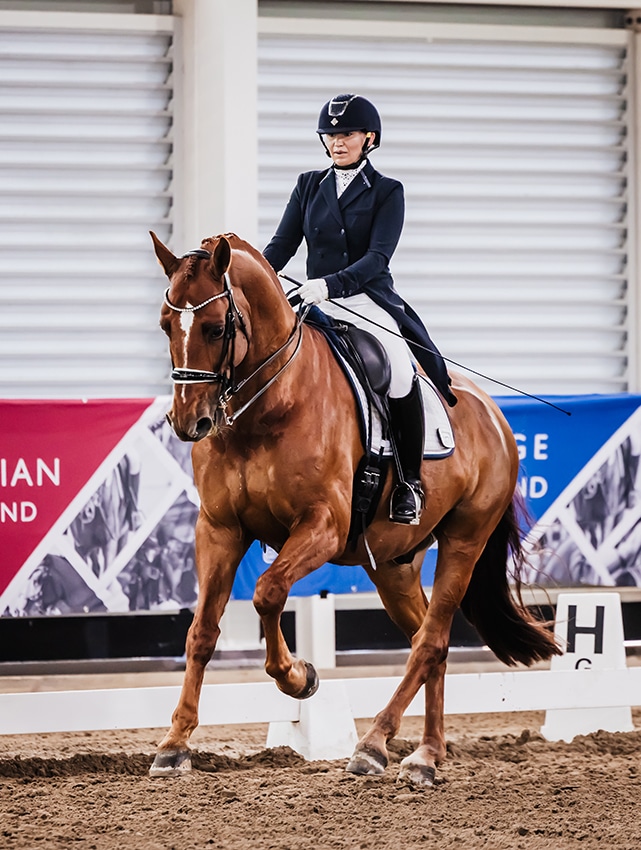
Lisel Dingley and Elmos Fire VIP competing at the 2026 Brisbane CDI. Image by Picture The Moment Photography.


How often do you feel yourself focusing on a movement and, when it isn’t working, doubling down and focusing even more on that movement? Flying changes, pirouettes, halts, or really any movement. Any rider can fall victim to this approach, and I suspect almost every dressage rider does, including me.
Especially when training Carousel Oasis through to Grand Prix, it was hard not to focus on the flying change issues as a flying change issue, rather than a symptom.
Difficulty in a movement can come from many things – horse conformation, rider position, posture of horse and rider, strength, straightness, engagement, overall way of going, energy, and also the rider’s understanding of the movement.
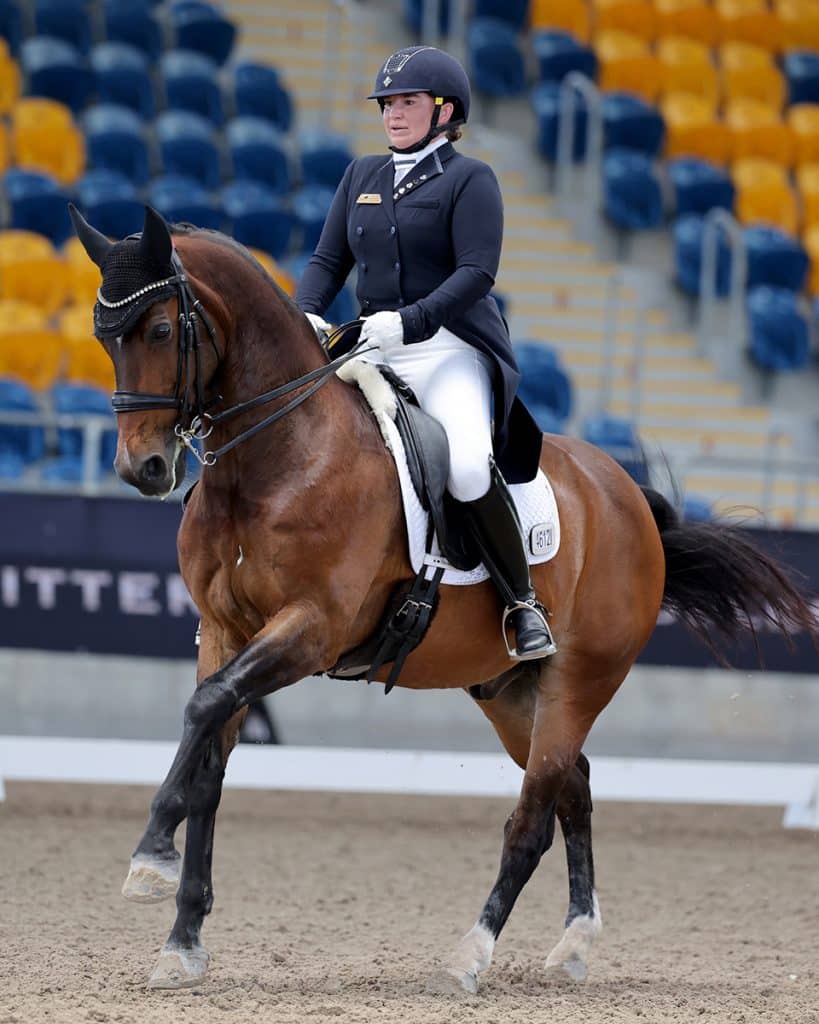
It took Carousel Oasis a while to learn a single flying change, but eventually the one tempi changes did become a highlight. Image by Derek O’Leary.
Some horses are more naturally able than others (like my current horse Elmo when compared to Oasis), but horses don’t do dressage by themselves. As I heard more than once at the 2026 FEI World Championships in Aachen, no matter the quality of the horse, the rider is an enormous part of the equation. A better rider can almost always produce better work on a more ordinary horse than a lesser rider can on a more talented one.
When horses learn to do a movement before all the jigsaw puzzle pieces are in place, it’s a testament to the horse’s trainability and the rider’s training ability, but you can find yourself stuck with issues into the future that are very difficult to fix.
RIDER’S INFLUENCE ON THE HORSE’S WAY OF GOING
If you, as a rider, are not sitting evenly, it isn’t fair to expect your horse to be straight and even. We know that inherently humans and horses are not perfectly straight and even. You need to identify your own and your horse’s balance and strength asymmetries, and work both on and off the horse to address these.
This needs to be dynamic – it’s normal to focus on one aspect and improve it so much that it is no longer the issue that needs addressing, then move on to the next aspect, while still maintaining what you just achieved.
Do not frame your horse or yourself as “weaker on the right” or having a “bad left arm”. It may be today’s challenge, but you must not let it define you or you will never move on. There is always something for everyone, and if there isn’t, you aren’t looking hard enough.
When you are riding, focus on increasing awareness of your own body and how it interacts with gravity. Can you feel the same pull downwards through both seat bones and both feet? Do both your shoulders relax down and back evenly? Does it take similar effort to hold your hands evenly against gravity?
Oasis was a horse who really wanted me to sit in a position that matched his asymmetries, and he would constantly try to bump me back to where he felt comfortable. My first intention was to use strength and stiffness to resist this, but this is not the solution.
The horse must not dictate your position, but equally, you cannot hold yourself in the “correct” position through strength. You just need to keep putting yourself back in the correct position, over and over again (even if it is every few strides!), while addressing why the horse feels they need to put you there, until one day you don’t need to anymore!
But then there will always be something else to focus on.

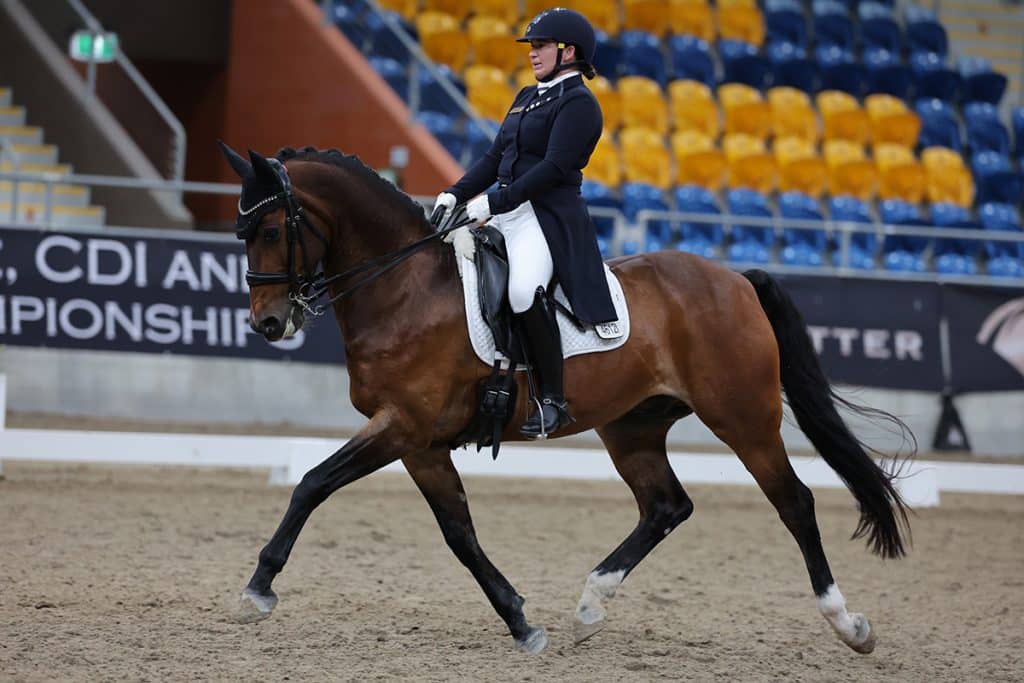
Staying in the correct position aboard Carousel Oasis took time and consistency. Image by Derek O’Leary.
DON’T TRY TO FIX STIFFNESS BY WORKING ON THE STIFFNESS
What feels like stiffness in your horse to you as the rider may actually be the result of weakness or a lack of engagement somewhere else. Rather than focusing on the stiffness, you need to find and improve what is missing that makes the horse feel like they need to do the thing that you interpret as stiffness.
Elmo is a BIG horse. As overheard from a fellow competitor at the Brisbane CDI presentation, he is “as solid as a rock”. There is no way I could ever be strong enough to flex him into softness, but more importantly, this approach runs the risk of teaching avoidance. They learn to bend left because you have pulled on the left rein 500 times, rather than learning to use their body correctly and overcoming the actual cause.
It’s our job to teach our horses how to engage the parts of them that they aren’t using when that lack of engagement is what is creating the feeling of stiffness. Most likely, the cause of an issue in front of the saddle is behind the saddle, so that’s where your focus needs to shift.
ALLOW THE ENERGY RATHER THAN MANUFACTURING IT
One of my biggest takeaways from watching almost every dressage test at Aachen was that those horses are on fire! They burst into the arena with such extreme positive tension that the vast majority of us would probably experience it as a feeling of being out of control, but their riders embrace it without negative tension in their own bodies, and with a smile on their faces.
We often learn that complete relaxation of the horse is an achievement – and it absolutely is – but relaxation is the foundation, not the end goal alone.
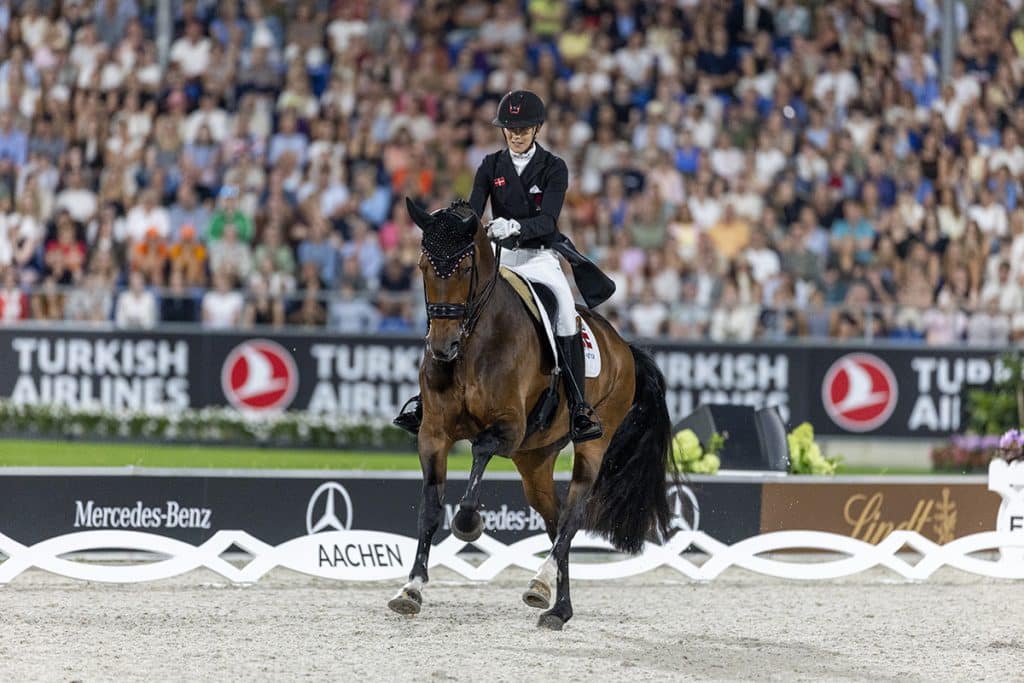
Cathrine Laudrup Dufour and Mount St John Freestyle showing plenty of energy at the FEI World Championships in Aachen. Image by FEI/Leanjo de Koster.
This has been particularly relevant with Elmo because he is naturally quite lazy. The obvious solution to a lazy horse is to keep asking for more – more leg, more reaction, more energy. But then it is very easy for the rider to become responsible for manufacturing and maintaining the energy. If the rider is fit enough, this can work at the lower levels, but it will become an almost impossible task around a Grand Prix test. Similarly, a horse whose energy is created through negative tension will lack the adjustability and willingness required for a good Grand Prix test.
What I am trying to develop instead is a horse who discovers that, as his body becomes stronger and more biomechanically correct, he has more energy available to him – and then becomes comfortable using it. My job is to set him up to find that energy, rather than continually creating it for him or forcing him to do it.
The other part of that is that when a naturally lazy horse suddenly does offer you a lot more energy, you can’t immediately shut it back down because it feels like too much! Elmo is not a hot horse, but he is big and strong, so when his energy is up it’s pretty full-on.
In the past I had to walk a very fine line (think “terrorist negotiator”) with Oasis, as he had a very fine line between processing the information and throwing the toys out of the cot. This taught me to step away a bit too quickly.
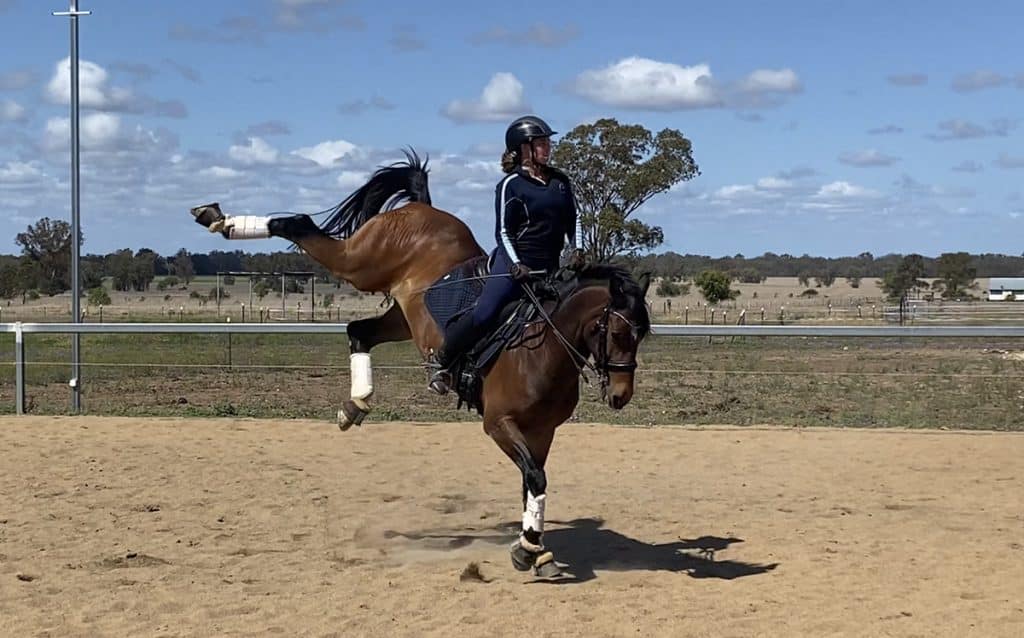
With Oasis, there was “a very fine line between processing the information and throwing the toys out of the cot”. Image supplied.
With Elmo, I’m working to sit in discomfort for a little longer and allow him to explore that energy without immediately trying to contain it. Getting comfortable in this discomfort is a critical building block towards Grand Prix.
BIOMECHANICAL CORRECTNESS IS ALWAYS THE WAY
Connection, engagement – and therefore ultimately the movements – come from the correct way of going, rather than avoidance, force or simply finding a way to produce the movement.
Elmo being such a big, strong horse has really reinforced this for me. I am never going to be able to physically make him do a movement or go a certain way, nor is this how I want to ride. Rather than asking “how do I make this movement happen?”, I am focusing on “what needs to be in place for this movement to be able to occur?”
The same applies to the aids. A horse responding to an almost invisible aid because they are balanced, engaged and they understand the question is very different from a horse responding because they have learned there will be an unpleasant consequence if they don’t. Light aids themselves aren’t necessarily evidence of correct training – how you achieved that response matters.
COMPETITION AS A DIAGNOSTIC TOOL
Competition is useful because it tells you what is actually established in your training. At home, you can repeat something. You can prepare again. Do another circle (or five!). You can wait for the perfect moment, or decide today isn’t the day and come back to it tomorrow.
In a test, you have to do the movement at the marker whether the stars are aligned or not.
If something consistently falls apart in the competition arena, the answer isn’t to go home and practise that movement over and over. Instead, you need to acknowledge that the test has exposed one of those missing jigsaw puzzle pieces in the way of going. If it isn’t truly established at home, you cannot be disappointed when you don’t pull it off in the test!
You and your bank account might know the significance of a certain competition, but your horse doesn’t. For most of us, we aren’t at the Olympics or World Championships, nor are we competing for significant prizemoney. So, is getting the movement at the marker today really more important than maintaining the way of going you want for the future?
This was very much my focus with Elmo at the recent Brisbane CDI/Queensland State Championships. It was a significant competition, but for us it was another opportunity to test the training and have a training run around the Advanced tests, which we haven’t done many of. My mantra going in was “ride the horse, not the test” – although I may have taken that a little too literally and forgotten where I was going a few times!
If I sacrifice the horse’s way of going because I am so determined to perform a particular movement at a particular marker, I have started prioritising the movement over the training that is supposed to produce it.
At this stage of Elmo’s training, maintaining the correct way of going and seeing how that translates to the competition arena is more valuable than any one result.
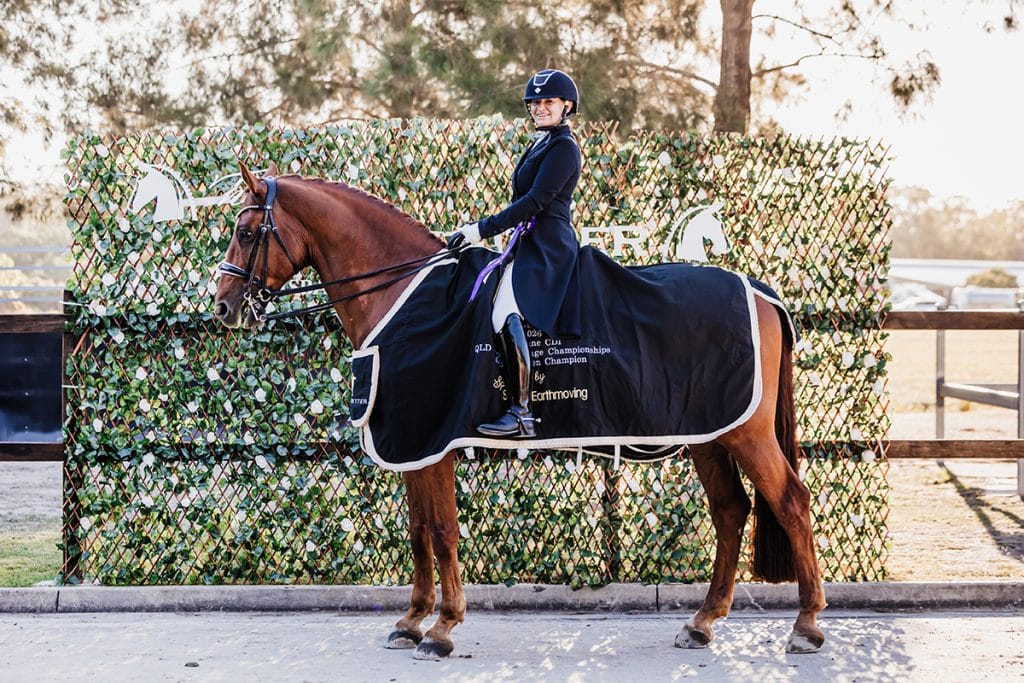
Lisel was determined to “ride the horse, not the test” at the Brisbane CDI, however she and Elmos Fire VIP (Estebar x Wolkentanz) did manage to pull off some excellent tests to claim both the Open Medium Championship and Open Advanced Championship. Image by Picture The Moment Photography.
PUTTING THE PIECES TOGETHER
Ultimately, good training should continually improve both the horse and the rider. We are not just teaching horses a series of movements – we are developing their bodies, balance, strength and understanding, while hopefully doing exactly the same for ourselves.
Horse and rider also don’t develop independently. Every asymmetry, compensation or change in one affects the other. Sometimes the horse needs to change. Sometimes the rider does. Usually, it’s probably a bit of both. Done correctly, riding should improve the way both horse and rider use their bodies. Done incorrectly, you may both end up needing “fixing”.
There will always be another jigsaw puzzle piece to find – in the horse, in the rider, or in our understanding of what we are trying to achieve. The goal is to keep identifying those missing pieces and develop the skills to address them correctly. And then the movements are just the outcome.
About the author: Lisel Dingley brings a systems-based approach to both business and riding. Balancing horses and a full-time career as the owner of Dynamic Environmental Services supporting some of the largest projects in Queensland, Lisel understands how important it is to make every ride count. She offers a small number of one-on-one mentoring sessions for riders who want to build better systems around their training, horse and land management, and integrating horses with a career outside of horses, to achieve more consistent progress.
If that sounds like you, get in touch via email to [email protected] – mentoring availability is limited. EQ
Related articles

If you aren't improving between your dressage lessons, the problem probably isn't your coach, but your system.

“Not one movement has been easy; every single aspect has been a challenge,” laughs Lisel Dingley in reference to her Grand Prix journey with Carousel Oasis. It’s taken a challenging 18 years of training, but last month the pair enjoyed their international-level debut at the Brisbane CDI.